The right cap supplier must do more than quote a unit price: it must control specifications, decoration, approvals, packing and delivery against your use case. By the end, you will be able to compare suppliers, calculate a defensible order quantity and set purchase terms that protect retail replenishment, corporate uniformity or an event deadline.
Key takeaways
- Classify your order as retail stock, corporate branding or event distribution.
- Compare fabric, fit, closure, stitching and colourfastness—not catalogue photos.
- Approve a physical branding sample before authorising bulk production.
- Set carton counts, delivery dates and inspection checks in writing.
Start with the order type and supplier terms
Classify the purchase before comparing prices: a retail cap supplier must support repeatable stock, corporate cap orders require controlled branding, and an event cap supplier must meet a fixed distribution date.
| Order type | Terms to compare | Quote question |
|---|---|---|
| Retail | Minimum order quantity by style, colour and decoration; carton quantity; repeat-order lead time | Can you reproduce the same colour and fit for replenishment? |
| Corporate | Sample approval; artwork setup; production lead time; replacement policy | Which approved sample controls every unit? |
| Event | Stock availability; delivery schedule; freight responsibility; late-order capacity | What delivery date is guaranteed, and how are cartons allocated? |
Ask each supplier to show the minimum order quantity separately for each cap style, fabric or colour, and decoration method. One combined total may still trigger separate dye-lot, cutting, embroidery-digitisation or setup charges.
- Request a physical sample, decoration proof, payment terms, carton count and freight basis before comparing landed cost.
- If embroidery will sit on an unstructured crown, specify maximum artwork dimensions and clearance from seams and eyelets; dense fills can pucker.
- For polyester performance caps, approve a transfer on the actual fabric because dye migration can appear during curing.
- For U.S. sales, confirm fibre-content disclosure, the responsible business or FTC RN, and country-of-origin marking. Ask whether origin is woven, printed or sewn; a removable hangtag alone may not suffice.
- If using AQL, name the inspection standard, lot size, inspection level and critical, major and minor defect limits. AQL is a sampling parameter, not a defect guarantee.
Compare the cap specification, not just the catalogue photo
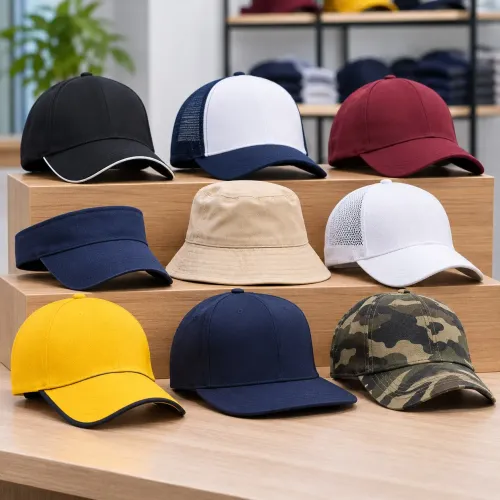
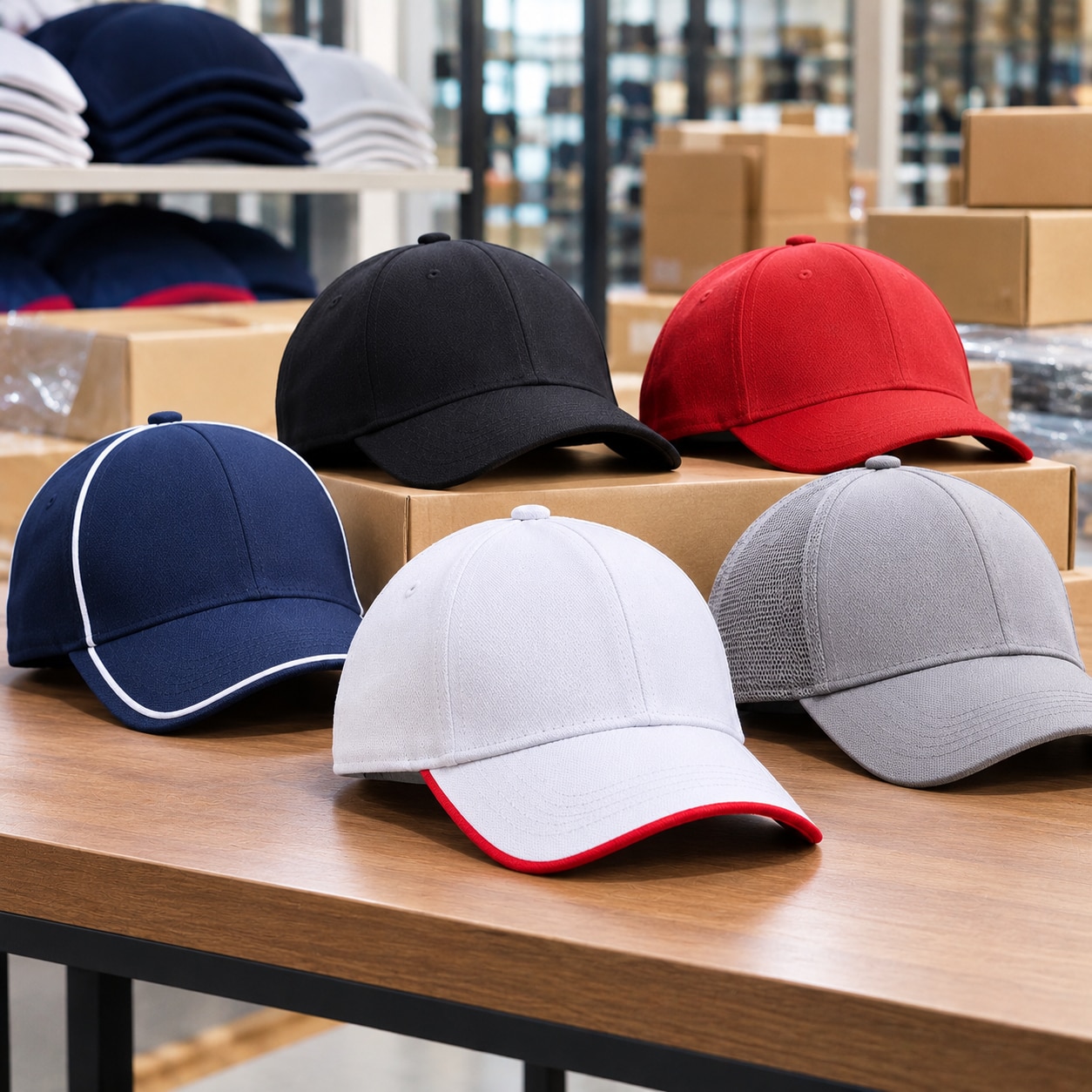
A catalogue photo cannot establish comparability: match the cap fabric composition and cap fabric weight, crown construction, panel count, closure, dimensions and decoration method before comparing price. A black six-panel cotton cap is not equivalent to a lightweight polyester five-panel cap simply because both appear black.
| Detail | Match before comparing | Why it changes the product |
|---|---|---|
| Fabric and crown | Fibre percentages, fabric weight, and a structured cap or unstructured cap | Changes drape, breathability, shape retention and perceived quality |
| Construction | Five-panel or six-panel build, seam placement and front-panel height | Affects logo area, fit and the cap’s appearance on different heads |
| Fit and finish | Closure type, head-size range, brim shape, colourfastness and shade reference | Determines adjustability, wear comfort and colour continuity across replenishments |
| Decoration | Embroidery size and stitch count, patch dimensions, or transfer film and curing method | Changes durability, detail, cost and the risk of dye migration on polyester |
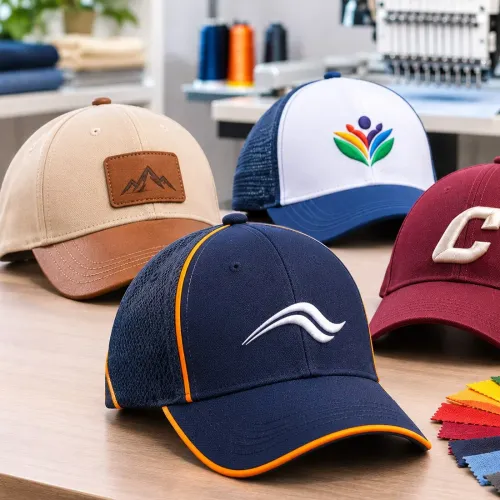
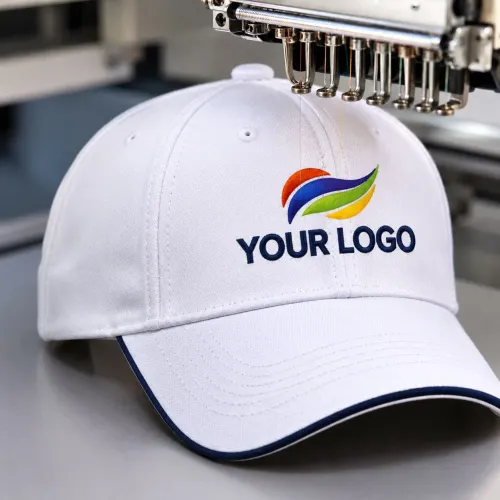
Treat branding as a physical specification, not just supplied artwork. A vector logo still needs digitization for stitch direction, underlay, density, pull compensation and crown curvature; approve a sew-out, especially for small text and thin strokes. For heat transfer, approve a sample on the actual fabric and transfer chemistry.
Ask for evidence behind recycled-content claims: recycled polyester alone does not prove a whole-product environmental benefit. If caps target children in the United States, review accessible metal adjusters, snaps, patches and prints against the 100 ppm lead limit and 0.1% phthalate threshold, plus tracking-label requirements.
Calculate quantities and approve branding before production
Set the bulk cap quantity from confirmed demand, then add protection against predictable loss. Use this calculation: required quantity = staff, attendees or planned retail units + replacements and damaged units + a reserve for late registrations, new hires or replenishment.
Retail orders need repeatable sizing, colour continuity and enough stock for the next sales cycle; event orders need the full quantity at the venue before the fixed distribution date.
1. Count each cap style, fabric colour and decoration method separately. Ask the quote to show the minimum order quantity for every combination. Combining five colours into one total does not necessarily remove separate dye-lot, cutting, embroidery-digitization or setup charges.
2. Request the artwork proof and decoration specification before paying a production deposit. For cap embroidery, approve a physical sew-out that shows stitch direction, underlay, density, pull compensation and small text on the curved crown. Vector artwork alone is not production approval.
3. For heat-transfer printing on polyester performance caps, approve a sample using the actual fabric and transfer chemistry. Dye migration can bleed the base colour into the transfer during curing or later heating, even when a paper proof looks correct.
4. Order a pre-production sample made from the actual blank. Check the closure, sweatband, visor construction, crown seams, label visibility, decoration and packaging configuration before signing approval. Record the approved colour reference, logo size, placement, carton quantity and delivery date in writing; production changes after approval create rework and delay.
Match packing and delivery controls to the buying channel
Retail stock needs shelf-ready units and consistent replenishment; corporate uniform caps need controlled allocation; event orders need arrival certainty more than presentation packaging.
| Channel | Packing control | Delivery control |
|---|---|---|
| Retail | Use individual retail cap packaging with size, colour, style, barcode and care information where required. Pack identical units together and confirm carton quantities before dispatch. | Hold colour and size continuity across replenishment orders. Confirm stock availability, repeat-order lead time and freight responsibility. |
| Corporate uniforms | Pack corporate uniform caps by department, location, size or employee group. Mark cartons clearly so supervisors do not have to open every carton to issue them. | Deliver against the workforce rollout plan, with separate shipment dates for sites or new-hire batches. Keep approved samples and branding records tied to each repeat order. |
| Events | Pack by distribution point, session, team or registration group, using countable inner packs rather than one mixed carton. Add a small reserve for late registrations and damaged units. | Set the event delivery schedule around the venue’s receiving hours, installation deadline and storage capacity. Use split shipments only when each delivery has a named recipient and carton count. |
Put the packing plan and dispatch milestones in the purchase order. Ask for carton dimensions, gross weight, carton quantities, packing photographs, tracking details and a replacement process for shortages or transit damage. A low unit price is irrelevant if mixed cartons delay issue day or a late truck misses the event.
Protect quality, compliance and repeat orders
Put measurable acceptance, labelling and reorder terms in the purchase order; a catalogue description cannot settle a dispute over shade, stitching or compliance.
1. Define the AQL cap inspection before production. Reference ISO 2859-1, state the lot size and inspection level, and specify the sample size and accept/reject numbers. List critical, major and minor defects separately: a broken child-safety component can be critical, exposed seams major, and a small thread tail minor.
AQL is a sampling parameter, not a promise that the shipment contains no defects.
2. Attach the approved sample, decoration artwork, measurement tolerances and cap colour matching standard. Name the colour system or physical swatch, then require written approval of a pre-production sample and a retained production reference. Reject cartons with shade drift, incorrect embroidery, wrong closure or measurements outside the stated tolerance.
3. State every required label for the destination market. For U.S. sales, identify fibre content, the responsible business and FTC RN where required, plus country of origin marking. Confirm whether the origin mark is woven, printed or sewn; a removable hangtag alone may be inadequate.
4. If caps are marketed primarily to children, require children’s product compliance records, including testing or certification, a permanent tracking label, 100 ppm total lead limit for accessible components and the 0.1% phthalate threshold for covered plasticized components.
5. Record the approved style, colour, fabric, decoration method, MOQ, carton quantity, unit price and reorder lead time. Require Promotional Cap Manufacturer to retain the approved sample and artwork, and define replacement or credit terms for failed units and the process for matching future dye lots.
Related product
 | SCHOOL CAP MANUFACTURERS We Are Best School Caps Manufacturers in Pune Maharshtra India , School Caps suppliers, exporters, wholesalers and distributors in Pune Maharshtra... View product → |
Frequently asked questions
How do you choose a cap supplier for a bulk order?
Match the supplier to your buying channel, then compare written specifications, branding controls, packing standards and delivery capacity.
What cap specifications should you compare?
Compare fabric composition and weight, crown construction, size range, closure type, visor shape, stitching, colour references and embroidery or print dimensions.
How many caps should you order?
Calculate confirmed recipients or expected sales, add a defined replacement or size allowance, and separate samples from the production quantity.
How can you prevent branding errors before production?
Approve artwork dimensions, thread or ink colours, placement, spelling and a physical or digital production sample before signing off the bulk run.
What delivery controls matter for event and retail cap orders?
Specify carton quantities, inner packing, labels, dispatch date, delivery address, inspection window and the contact responsible for resolving shortages or defects.